
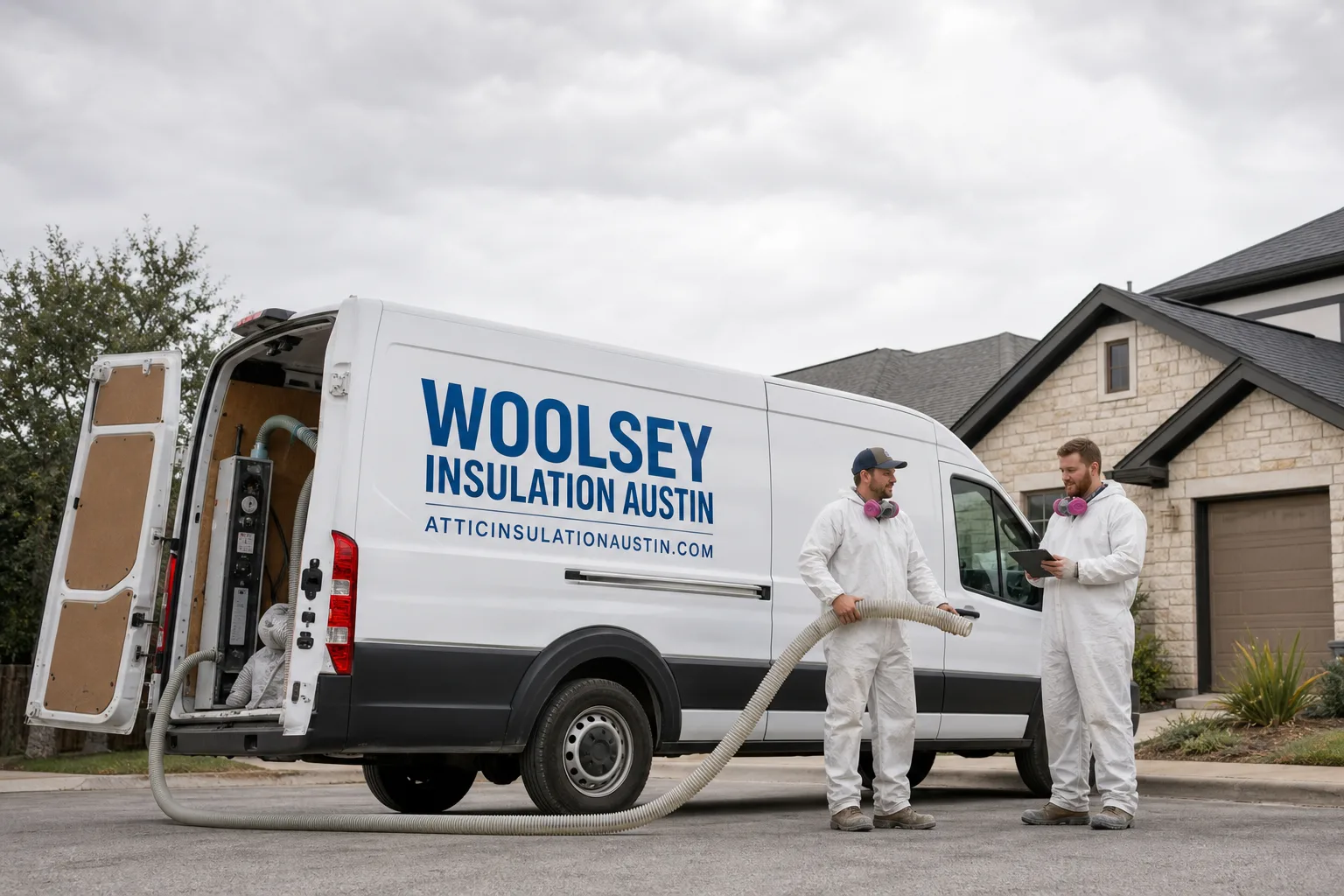
How Much Does Blown-In Insulation Cost in Austin?
Blown-in insulation in Austin typically costs between $1,800 and $4,200 for an average 1,500-square-foot attic, with most homeowners paying around $2,800 for full coverage to R-38. Fiberglass runs $0.80 to $1.50 per square foot installed, while cellulose lands between $1.00 and $1.75 per square foot. At Woolsey Insulation Austin, every quote is a written, line-item price delivered before any work starts, so the number you see is the number you pay.
We’ve been installing blown-in insulation in Austin attics since 2002, and the range above reflects what we’re actually seeing across Round Rock, Cedar Park, Pflugerville, Georgetown, Leander, Buda, Kyle, and central Austin neighborhoods like Hyde Park, Mueller, Allandale, and Tarrytown. Your exact cost depends on attic size, current insulation depth, access difficulty, and the material you choose. Keep reading for a full breakdown of 2026 pricing, what drives costs up or down, and how to get an exact written number for your home.
This guide covers the real numbers, the factors that move them, and the questions worth asking before you hire anyone. If you’d rather skip the reading, call us at (361) 418-9997 and we’ll walk through your attic over the phone.
Need a quick orientation to the service itself? Start with our Blown-In Insulation in Austin guide, then come back here for the dollar figures.
Key Takeaways:
- Most Austin attics cost $1,800 to $4,200 for blown-in insulation to R-38 in 2026.
- Cellulose costs slightly more per square foot than fiberglass but performs better in Austin’s summer heat by resisting airflow.
- Attic air sealing, when done alongside insulation, adds $400 to $900 and is the single highest-ROI upgrade in this market.
- Material costs have risen 12% since 2023, driven by regional supply constraints and Austin’s ongoing construction volume.
- Woolsey Insulation Austin delivers a written price before any work begins – no door-step surcharges, ever.
Blown-In Insulation Cost Breakdown (2026)
Here’s what a typical blown-in attic insulation job costs in the Austin metro as of early 2026. These are real installed prices, not material-only figures:
| Line Item | Cost Range (Austin Metro) | Notes |
|---|---|---|
| Blown-in fiberglass, R-38, 1,000 sq ft attic | $800 – $1,500 | Most common budget-conscientious choice |
| Blown-in cellulose, R-38, 1,000 sq ft attic | $1,000 – $1,750 | Denser, better air-blocking in Texas heat |
| Blown-in fiberglass, R-38, 1,500 sq ft attic | $1,200 – $2,250 | Typical 3-bedroom Austin ranch or two-story |
| Blown-in cellulose, R-38, 1,500 sq ft attic | $1,500 – $2,625 | Popular for 1990s-era homes in Cedar Park and Round Rock |
| Blown-in fiberglass, R-38, 2,000+ sq ft attic | $1,600 – $3,000 | Common for Tarrytown, Westlake, and newer Leander builds |
| Attic air sealing (before blowing insulation) | $400 – $900 | Caulks and foams top plates, wire penetrations, can lights |
| Old insulation removal (per 1,000 sq ft) | $500 – $1,200 | Needed when old insulation is wet, rodent-damaged, or moldy |
| Rafter baffles / ventilation (per linear foot) | $2.50 – $4.50 | Keeps soffit vents open so the attic breathes |
| Attic hatch insulation and weatherstripping | $75 – $200 | Often overlooked; stops a surprising amount of heat transfer |
These numbers come from jobs we’ve priced and completed in the Austin metro since the start of the year. They reflect installed cost, which includes material, labor, equipment setup, and cleanup. If you’ve gotten quotes below the low end of these ranges, ask whether the contractor is actually bringing the attic to R-38. Austin building code requires R-38 for new construction, and a lot of “cheap” bids are for R-30 or less, which leaves real money on the table every summer.
The material choice matters more than most people expect in this climate. Fiberglass is lighter and slightly cheaper, but cellulose gets its edge because it’s denser. In an Austin attic that hits 140 degrees in August, the dense pack resists air movement better, which means less hot air sneaking into your living space. That performance difference is worth the extra $0.20 to $0.25 per square foot for many homes, especially if your HVAC air handler is in the attic, which is common in 1960s through 1990s Austin builds.
What Affects Blown-In Insulation Pricing in Austin
- Current insulation depth (or lack of it). A bare attic is straightforward – we blow to full R-38 depth. An attic with 4 inches of old, settled fiberglass needs a topping layer of maybe 8 to 12 inches. The more existing material we’re blowing over, the more material you need, and the more the price shifts toward the top of the range.
- Attic access and headroom. Some Austin homes have generous walk-up attic stairs. Others have a 22-inch scuttle hole in a closet ceiling, and the tech has to haul the hose through the house, up a ladder, and work on knees in a 4-foot-high space. The tighter the attic, the longer the labor, the higher the price. Homes in Allandale and Crestview, with their 1940s and 1950s rooflines, often fall into this higher-labor category.
- Air sealing before insulation. This is the upgrade that separates a good job from a great one in Austin’s climate. Before we blow anything, we foam and caulk the top plates, plumbing penetrations, electrical boxes, and recessed can lights. The $400 to $900 this adds is usually recouped within two years through lower summer electric bills. Homes in Mueller, built pre-2015, are prime candidates because the original insulation left thousands of unfilled penetrations.
- Old insulation condition. If raccoons, squirrels, or roof leaks have turned your existing insulation into matted, contaminated waste, it has to come out before new material goes in. Removal costs $0.50 to $1.20 per square foot in Austin, depending on depth and access. It’s not optional – old, damp insulation carries mold spores and stops new insulation from performing.
- Attic square footage above the heated, cooled part of the house. Garages aren’t part of the conditioned envelope and shouldn’t be insulated to R-38. But cathedral ceilings, bonus rooms, and knee-wall attics all count. If your home has a second-story bonus room over the garage, that floor area adds directly to the insulation square footage.
- Pre-existing ventilation issues. If your soffit vents are blocked or you don’t have enough of them, we add rafter baffles before blowing. Skipping this step in an Austin attic creates a mold risk, because the underside of the roof deck gets too hot and trapped moisture has nowhere to go. The $2.50 to $4.50 per linear foot this costs is cheap insurance against a $4,000 mold remediation bill later.
How to Save on Blown-In Insulation
The honest way to save money on insulation isn’t by cutting corners on material depth. R-38 is R-38, no matter who installs it. The savings come from timing, planning, and making sure you’re paying for exactly what you need and nothing more. Here’s what actually moves the number:
1. Bundle air sealing with insulation. The marginal cost of air sealing is smaller when we’re already in the attic with equipment running. If you do air sealing later as a standalone job, you pay for a second mobilization, second setup, and second cleanup. Doing both at once typically saves $150 to $300 versus doing them at different times.
2. Check whether your utility is offering a rebate. Austin Energy and Pedernales Electric Cooperative have run insulation rebate programs in recent years, and some extend through 2026. At the time of writing, Austin Energy is offering up to $1.50 per square foot for qualifying attic insulation upgrades. These programs come and go, and the paperwork has to be filed correctly the first time. A reputable installer should know which programs are active and should give you the details in writing.
3. Get the depth right, not “more just in case.” R-38 is the target for Austin attics. R-49 is overkill for our climate and just adds cost. Some contractors will quote R-49 or R-60 because it’s a bigger number and a bigger invoice. For central Texas heat, R-38 with proper air sealing and ventilation outperforms R-49 without them, and it costs 20% to 30% less.
4. Don’t pay for attic insulation you don’t need. If your garage ceiling isn’t under conditioned space, it doesn’t need R-38. If you have a screened porch with an attic above it, that space shouldn’t be insulated. A careful audit of what’s actually part of your conditioned envelope keeps the square footage honest. At Woolsey, we measure the attic and give you the exact square footage calculation on your written quote, so you can verify the math yourself.
5. Plan for a weekday install if you can. Austin insulation crews are busiest on weekends. If you can schedule midweek, some companies (including ours) can sometimes offer more flexibility on scheduling. It doesn’t change the material cost, but it can occasionally shave labor overhead when schedules align.
And the simplest one: get a written quote and compare it line by line. If one bid says R-38 and another says R-30, the cheaper bid isn’t cheaper. It’s just less insulation. We give every Austin homeowner a written price before any work begins, with the depth, the material type, and the square footage spelled out. Call (361) 418-9997 and we’ll do the same for your home.
Cellulose vs. Fiberglass: The Real Difference in Austin
You’ll hear both terms thrown around when you start collecting quotes. Here’s the plain-language version: fiberglass is glass spun into thin fibers and blown into place. Cellulose is recycled paper treated with borate fire retardant and blown in with a denser, more solid pack.
In Austin’s specific climate, the differences show up in two ways:
Air movement. Cellulose is denser, which means it curbs the “stack effect,” the hot-air-rushing-up, cold-air-rushing-in cycle that pulls attic heat into your living room. In August, when your attic is 140 degrees and your living room is trying to hold 75, that difference is measurable. We’ve done before-and-after airflow tests on Austin homes and seen 20% to 30% less air movement through cellulose-treated attics than through fiberglass-only attics.
Settling. All blown-in insulation settles over its first year. Cellulose settles less, which means the R-value you pay for is closer to the R-value you’re still getting three years later. Fiberglass loses a bit more loft, which is why we typically blow fiberglass an inch or two deeper than the target depth if a homeowner insists on fiberglass for budget reasons.
The cost differential in Austin right now is modest: about $200 to $400 more for cellulose on a typical 1,500-square-foot attic. Both materials are good. The choice comes down to whether you’d rather save that next $300 now or recoup it in lower summer bills over the next few years. Glenn Hartley, who runs Woolsey Insulation Austin, typically recommends cellulose for attics in this market unless the existing material mix or an unusual attic shape makes fiberglass the better call.
Signs You Have an Insulation Problem That’s Costing You Money
Plenty of Austin homeowners don’t think about insulation until a room feels hot, or the July electric bill arrives. Here’s what actually signals an insulation deficit:
- Upstairs rooms are consistently 8 to 10 degrees hotter than downstairs in summer. That’s not just “how it is.” It’s inadequate attic insulation and likely poor air sealing.
- The air conditioner runs in long, continuous cycles in summer. If your AC can’t shut off between 2 p.m. and 8 p.m. in August, the system is fighting heat gain from the attic as much as from the outside air.
- Snow melts off your roof faster than your neighbors’ roofs. Rare in Austin, but frog-strangler cold snaps happen. If your attic is under-insulated, heat escapes, and frost melts quicker on your roof. It’s a classic sign in February and a preview of what’s happening in July, just in reverse.
- You can see the top of your ceiling joists. If the insulation doesn’t cover the joists, you’ve got maybe 4 to 6 inches of material. You need roughly 10 to 14 inches, depending on material, to hit R-38. The joists should disappear entirely under the fill.
- Your attic has old, dark, crunchy insulation that crumbles when touched. That’s settled, degraded fiberglass from decades past. It’s not doing much at this point. Blowing fresh material over it can work, but sometimes the old stuff needs to come out first.
If any of these sound familiar, the fix is usually measured in hours, not days. Most blown-in attic insulation jobs in Austin are completed in one day, including cleanup. Larger attics or jobs requiring full removal sometimes extend to two days, but that’s the exception.
How a Woolsey Insulation Austin Job Runs
We don’t send a salesperson with a script and a financing presentation. The process is simpler than that:
1. You call. A live person answers, 24 hours a day, every day. That’s a standing fact about how we operate. No answering service, no voicemail maze. You’ll tell us what’s going on: hot upstairs rooms, high bills, a recent energy audit, whatever prompted the call.
2. We schedule a free measurement visit. A background-checked, uniformed technician comes to your home at a committed arrival window. They measure the attic square footage, check current depth, assess access, look for air-sealing needs and ventilation problems, and document everything.
3. You get a written price. Before any work starts. It lists the square footage, the material type, the target R-value, the air sealing scope, the baffle count, and the exact dollar figure. No “well, once we got in there” price changes.
4. We do the work. The crew shows up in the window, lays floor protection down, blows the insulation to the specified depth, seals what needs sealing, and cleans up. The job site is cleaner when we leave than when we got there, and the number you owe hasn’t moved.
5. You get it in writing. Every Woolsey job includes The Kingswell Guarantee: a written price before work starts, a committed arrival window, a clean job site, a written guarantee on the work, and a free return visit if any repair fails within 365 days. That’s the specific, verifiable promise behind every job we do. It’s not a slogan; it’s the warranty you take home.
The name Woolsey isn’t accidental. Wool was the first insulation. Woolsey keeps the idea in the name, and it keeps the same idea in every attic we treat: honest material, honest depth, honest price.
What About Spray Foam? A Quick Cost Comparison
Some Austin homeowners ask about spray foam for their attic instead of blown-in insulation. It’s a fair question. Spray foam – a two-part liquid that expands on contact and seals gaps airtight – runs $3.50 to $7.00 per square foot installed in the Austin market, depending on whether it’s open-cell or closed-cell foam and whether it’s being applied to the roofline or the attic floor.
That’s roughly three to five times the cost of blown-in insulation per square foot. Spray foam has real advantages for certain situations: unvented attics, cathedral ceilings, homes with HVAC equipment in the attic, and homes where the attic is being converted to living space. But for a standard vented attic with a traditional roof, blown-in insulation at R-38 with proper air sealing delivers strong performance at a fraction of the cost, and the payback period in Austin’s utility market is typically 2 to 4 years, versus 7 to 10 years for spray foam on the roofline.
Woolsey installs both. That’s why we can give you a straight comparison instead of steering you toward whichever we happen to sell. We work with eight leading insulation brands: Owens Corning, Johns Manville, Knauf, Rockwool, CertainTeed, Icynene, Demilec, and GreenFiber. The material recommendation fits the home, not whatever happens to be on the truck.
Glenn and our team will tell you if blown-in insulation is the right call, or if spray foam genuinely makes more sense for your attic’s specific geometry. There’s no upside in selling a homeowner the wrong material. Word gets around in Austin, and we’ve been here too long to trade a short-term invoice for a long-term reputation.
FAQs – Blown-In Insulation Cost
How much does blown-in insulation cost for a 1,500 sq ft attic in Austin?
For a 1,500-square-foot attic, expect to pay between $1,200 and $2,625 in 2026, depending on material and whether air sealing is included. The sweet spot for most Austin homes is around $2,800 all-in with cellulose and basic air sealing. Call (361) 418-9997 for an exact written quote on your home’s specific square footage.
Is blown-in insulation cheaper than spray foam in Austin?
Yes. Blown-in insulation costs $0.80 to $1.75 per square foot installed in Austin, while spray foam runs $3.50 to $7.00 per square foot. Blown-in is the right choice for most vented attics; spray foam earns its cost only in specific situations like unvented rooflines or HVAC-in-attic configurations.
Can you blow insulation over existing attic insulation?
In most cases, yes, as long as the existing insulation is dry, mold-free, and not rodent-contaminated. We blow fresh material over it to bring the total depth to R-38. If old insulation is wet or damaged, it costs $500 to $1,200 per 1,000 square feet to remove before new material goes in.
How long does blown-in insulation last in Austin’s climate?
Properly installed blown-in cellulose or fiberglass lasts 20 to 30 years in an Austin attic. Austin’s extreme summer heat accelerates settling, which is why we recommend a depth check every 5 to 7 years, especially if you’ve had roof or AC work done that might have disturbed the material. The 365-Day Done Right Promise means if anything isn’t right within the first year, we come back and fix it at no charge.
Does blown-in insulation help with cooling costs in Austin?
Yes. In Austin’s climate, upgrading from R-11 or R-19 to a properly air-sealed R-38 attic typically cuts cooling costs 15% to 25%, depending on your home’s orientation, window area, and AC efficiency. The payback period in Austin utility rates is usually 2 to 4 years. Call (361) 418-9997 and we’ll give you an honest assessment for your home’s specifics.
Get Your Exact Austin Insulation Price Today
You don’t need to guess. You don’t need to wonder if the contractor will pad the number at the door. You need a written price for your actual attic, with the actual material and the actual depth, delivered before any work starts. That’s what Woolsey Insulation Austin does, on every job, no exceptions.
Call us at (361) 418-9997 or visit our home page to learn more about how we work. A live person answers, day or night. We’ll schedule a free measurement visit, give you a written price, and if you hire us, we’ll do the work, clean the job site, and put the guarantee in writing.
The attic isn’t the most glamorous room in the house. But for what it costs to fix it right, it’s the best dollar-for-dollar improvement you can make to an Austin home. Let’s get you a number.
Pricing reflects the Austin market as of 2026. Woolsey Insulation Austin offers free estimates – call (361) 418-9997.
Written by Glenn Hartley, Owner at Woolsey Insulation Austin, serving Austin and the surrounding metro since 2002.
What Our Customers Say
"The guy didn't try to sell me on foaming the whole house. He said the attic was where I'd actually feel it and left it at that. Honest, and he was right, our bills dropped."
- Angela Ruiz"Drafty old house that never felt comfortable. After the attic and some air sealing it's a different place. On time, clean, and the quote didn't change. Wish I'd done it years ago."
- Dmitri Kozlov"Insulation job was done well. Scheduling took a little longer than I'd have liked, they were booked out a couple weeks. But once they came it was quick and the house is cozier."
- Felicia Grant