
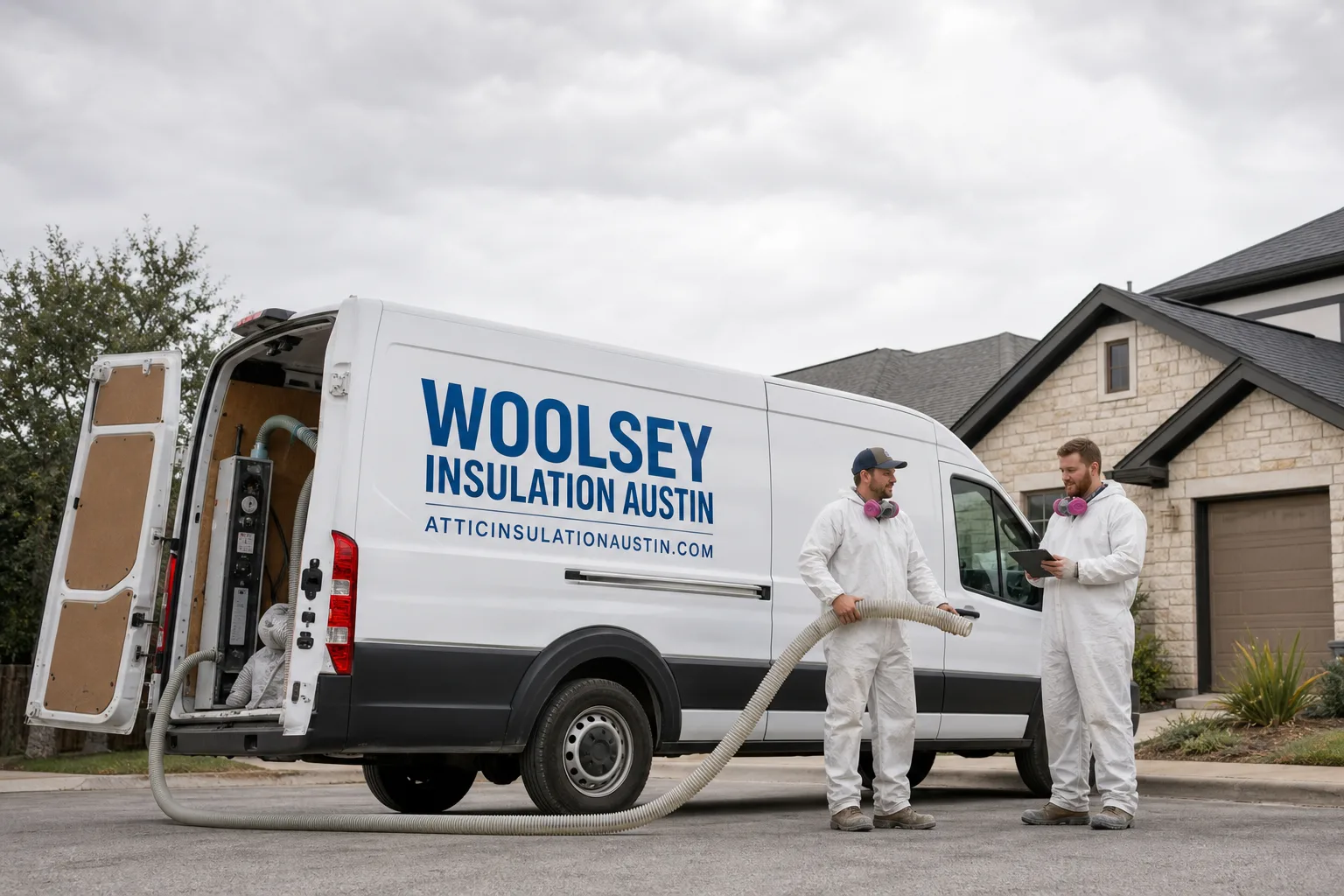
How Much Does Wall Insulation Cost in Austin?
Wall insulation in Austin, TX typically costs $1,800 to $4,200 for a standard single-story home, with most homeowners paying around $2,800 for complete exterior wall coverage. Blown-in insulation for existing walls runs $1.50 to $3.50 per square foot installed, while spray foam runs $2.00 to $5.00 per square foot depending on whether you choose open-cell or closed-cell. We give you a written, line-item price before any work starts, so the number you see below is the number you pay.
If you want the short version: most Austin wall insulation jobs land between $1,800 and $4,200, and a free estimate from us takes about an hour and includes the exact written number. Call (361) 418-9997 and a real person answers, any hour of the day.
Wall Insulation Cost Breakdown (2026)
Here’s what we’re seeing across Austin in 2026, broken down by insulation type and application. These are all-in numbers: material, labor, equipment, and cleanup included.
| Insulation Type | Cost per Sq Ft (Installed) | Typical Austin Home (1,500 sq ft) | Best For |
|---|---|---|---|
| Blown-in fiberglass (existing walls) | $1.50 – $2.75 | $2,250 – $4,125 | Retrofit, older homes |
| Blown-in cellulose (existing walls) | $1.75 – $3.00 | $2,625 – $4,500 | Retrofit, eco-friendly option |
| Open-cell spray foam | $2.00 – $3.50 | $3,000 – $5,250 | New construction, open stud bays |
| Closed-cell spray foam | $3.00 – $5.00 | $4,500 – $7,500 | Maximum R-value, air sealing |
| Fiberglass batts (new construction) | $1.00 – $1.75 | $1,500 – $2,625 | New builds, cost-conscious projects |
Those square-footage numbers reflect what we actually quote in neighborhoods like Allandale, Mueller, Circle C, and Wells Branch. A 1,500-square-foot home with standard 8-foot ceilings has roughly 1,100 to 1,400 square feet of wall cavity to fill, depending on window and door count. Homes in older Austin neighborhoods (Hyde Park, Travis Heights, Bouldin Creek) often run toward the higher end because stud spacing is irregular and we’re drilling into plaster or shiplap rather than drywall.
The single biggest cost driver is whether the wall is open or closed. If you’re building new or down to the studs during a remodel, insulation goes in fast and cheap. If we’re retrofitting an existing home, the job requires drilling access holes into each stud bay, blowing material in under pressure, and then patching those holes. That process takes longer and costs more, but it’s still far cheaper than tearing down drywall.
What Affects Wall Insulation Pricing in Austin
- Wall access (open vs. existing). Open stud bays take a fraction of the labor. Retrofitting a finished wall means drilling, blowing, and patching in every bay, which adds 40 to 60 percent to the labor cost.
- Home age and framing quirks. Austin homes built before 1980 often have true 2×4 framing with irregular spacing, plus obstacles like fire-blocking and diagonal bracing that slow the work down. Homes in areas like Crestview and Brentwood, where much of the stock dates to the 1950s and 60s, frequently need more access holes per wall. That shows up in the final number.
- Insulation material and R-value target. Austin sits in climate zone 2, where the Department of Energy recommends R-13 to R-15 for exterior walls. Hitting that with fiberglass batts costs less than hitting it with closed-cell spray foam. But spray foam also air-seals, which matters a lot in Austin’s summer heat. We’ll walk you through the trade-off in plain English before you commit to anything.
- Obstructions inside the wall cavity. Older Austin homes can have anything in there: knob-and-tube remnants, abandoned plumbing, rodent nests, settled insulation from a 1970s retrofit. We can’t see inside until we drill, and what we find affects how much material each bay takes.
- Access around the home’s exterior. If we’re drilling from the outside and your home has masonry, stucco, or hardboard siding in tight spots, the work goes slower. Austin’s mix of limestone, brick veneer, and wood siding means every neighborhood handles retrofits a little differently.
- Time of year. Insulation work in Austin’s attics and exterior walls runs year-round, but the late spring and early fall shoulder seasons fill up fastest because crews aren’t fighting 105-degree attic heat in August or the occasional January cold snap. Booking outside peak summer can sometimes mean more scheduling flexibility, though our pricing doesn’t change seasonally. It’s honest year-round.
Spray Foam vs. Blown-In: What Austin Homeowners Actually Ask Us
About half the calls we get from Austin homeowners come down to one question: should I pay more for spray foam or go with blown-in? Here’s the honest answer.
Blown-in insulation (fiberglass or cellulose) is the workhorse for existing walls. We drill a small hole into each stud bay, feed a hose through, and dense-pack the cavity until it’s full. The material settles into all the gaps, and the access holes get patched and touched up. It costs less, installs in a day, and you’ll feel the difference the next morning. Austin’s winter cold snaps are short but sharp, and blown-in insulation does a fine job keeping your heat inside when the temperature drops into the 30s.
Spray foam insulation is a two-part liquid that expands on contact and seals gaps airtight. It costs more, but it does two jobs at once: insulating and air-sealing. In Austin, where summer highs routinely hit 100 degrees and your AC runs for seven months straight, the air-sealing benefit is the real value. Air leaks through wall cavities are one of the most common reasons homes in places like Round Rock and Pflugerville have that one room that never cools down. Closed-cell foam also adds structural rigidity to the wall, which some Austin homeowners like in older pier-and-beam homes.
Neither is universally better. The right answer depends on your home’s construction, your budget, and how long you plan to stay. That’s a conversation we’re glad to have. We work with eight brands, including Owens Corning, Johns Manville, Knauf, Rockwool, CertainTeed, Icynene, Demilec, and GreenFiber, so the recommendation fits your home, not whatever happens to be on the truck that day.
How to Save on Wall Insulation in Austin
Insulation is one of those purchases where the cheapest quote often costs the most. That said, there are legitimate ways to keep the bill down without cutting corners.
- Get a written estimate first. Our price is written down before any work starts, every single time. No door-step surprises, no “we found something” upcharges halfway through. That’s The Kingswell Way and it’s been our standard since 2002.
- Prioritize walls, not just the attic. Attic insulation gets most of the attention, but walls account for roughly 20 to 30 percent of a home’s heat loss and heat gain. If your attic is already done, wall insulation in Austin is the next best dollar you can spend.
- Bundle multiple wall sections. If you’re doing the whole house at once, the per-square-foot cost drops because setup and mobilization get spread across more wall area. Doing one room at a time costs more per square foot.
- Ask about the material choice. Blown-in cellulose runs a bit more than fiberglass but performs better in irregular cavities and has a higher recycled content. If you’re cost-driven, fiberglass batts get you to code at the lowest price point. We’ll show you the numbers for each and let you decide.
- Take advantage of the free estimate. We’ll come out, measure your walls, check the existing insulation, and give you the written number. There’s no charge for this. Call (361) 418-9997 and we’ll schedule it.
One more tip specific to Austin: if your home was built between 2000 and 2015 in fast-growth areas like Cedar Park, Leander, or Kyle, take a look inside the walls before assuming they’re insulated. Some production builders of that era met minimum code with compressed batts that have settled badly over time, and we regularly find wall cavities in these neighborhoods that are barely half-full. The fix costs less than you’d think, and the comfort difference is immediate.
What the Kingswell Guarantee Means for Your Wall Insulation Project
Here’s how a wall insulation job runs when you work with Woolsey Insulation Austin. We’ll tell you the price, in writing, before anything starts. We’ll show up in the committed arrival window, with background-checked, uniformed technicians you can identify by name. We’ll leave the job site cleaner than we found it, every time. And the work itself comes with a written guarantee: 365 days, in writing, included on every job. If the insulation settles, fails, or doesn’t perform the way we said it would within that year, we come back and make it right at no charge.
That’s The Kingswell Guarantee, and it’s been our standard at every Kingswell location since 2002. We answer our phones around the clock with a live person, not an automated system. If you call at 3 a.m., a person picks up. That’s not a marketing line; it’s how we operate.
The name Woolsey traces back to wool, which was the first insulation material anyone ever used. Woolsey keeps the idea in the name. We’ve been insulating walls, attics, and crawl spaces long enough to know that the trust you place in a contractor is earned by doing exactly what you said you’d do. That’s the whole job, every job.
Wall Insulation Cost: Austin Neighborhood Notes
Different parts of Austin bring different pricing realities. Here’s what we see on the ground:
- Hyde Park and Travis Heights (pre-1940s): Plaster walls, shiplap, and irregular stud spacing mean more access holes and slower work. Expect the higher end of the blown-in range, around $2.50 to $3.00 per square foot for these homes.
- Crestview, Brentwood, Allandale (1950s-1970s): These mid-century homes typically have true 2×4 framing and standard spacing, which means cleaner drilling and faster fill. Blown-in costs here usually land between $2.00 and $2.75 per square foot.
- Mueller, Circle C, Steiner Ranch (1990s-2010s): Homes from this era usually have some existing insulation, but it’s often underperforming or settled. We’re typically topping off or replacing rather than starting from empty, which keeps material costs down despite the higher labor for drilling into denser sheathing.
- Round Rock, Pflugerville, Hutto (suburban growth): Production builds from 2000 to 2015 are the most common retrofit candidates here. These homes often have compressed fiberglass batts that were installed quickly. The job is straightforward, and pricing lands near the middle of the blown-in range.
We mentioned climate earlier, and it’s worth being specific: Austin’s summer heat is the reason wall insulation matters here. Your attic catches the sun, but your walls transmit heat all day long. When it’s 105 degrees outside and your AC is cycling constantly, poorly insulated walls turn every room into a slow oven by 5 p.m. The comfort problem you feel in July is often a wall insulation problem. We fix that.
FAQs – Wall Insulation Cost
How much does it cost to insulate the walls of a 2,000 square foot house in Austin?
For a 2,000-square-foot Austin home, expect $2,800 to $5,600 for blown-in wall insulation or $4,000 to $8,000 for open-cell spray foam in open stud bays. The spread comes down to whether walls are open or finished, what’s already inside the cavity, and how much trim and siding work is needed around access points. Call (361) 418-9997 for an exact written quote – estimates are free.
Is wall insulation worth the cost in Austin?
Yes. Austin’s cooling season runs from April through October, and wall insulation typically cuts 15 to 25 percent off a home’s annual cooling and heating bill, which works out to $300 to $600 per year for a typical Austin home. At that rate, a $2,800 wall insulation job pays for itself in five to nine years, and the comfort improvement is immediate. We install wall insulation in Austin year-round, and we price it honestly before touching anything.
What’s the cheapest way to insulate existing walls?
Blown-in fiberglass is the most cost-effective option at $1.50 to $2.75 per square foot installed. It’s installed through small access holes that get patched afterward, so there’s no drywall demolition. That said, blown-in cellulose at $1.75 to $3.00 per square foot is only slightly more and often performs better in irregular Austin wall cavities. We’ll show you both numbers and let you choose.
Can you come today to insulate my walls?
In most cases we can schedule an estimate within 24 to 48 hours, and installation can often begin within the same week. We don’t do “same-day” pressure tactics; we do committed arrival windows, and we show up when we say we will. Call (361) 418-9997 and a live person answers, any time of day.
How long does wall insulation installation take?
A standard single-story Austin home takes 4 to 8 hours for blown-in wall insulation, and most jobs are done in a single day. Two-story homes or homes with masonry siding can take a second day. Spray foam in open stud bays for a whole-house new build typically takes 1 to 3 days depending on square footage. We’ll give you a time estimate in writing alongside your price estimate.
Do I need a permit for wall insulation in Austin?
Most existing-home wall insulation retrofits in Austin do not require a permit, but new construction and major remodels fall under the building permit already issued for that project. Austin’s Energy Code falls under the 2015 IECC with local amendments, which sets R-13 as the minimum for exterior walls in climate zone 2. We’ll confirm code compliance for your specific project and include that in the written estimate.
The Kingswell Guarantee: What You Get With Every Wall Insulation Job
You get a written price before any work starts. You get a committed arrival window, and we show up inside it. You get background-checked, uniformed technicians whose names you’ll know before they walk through your door. You get a clean job site when we leave. You get a written guarantee on the work: 365 days, in writing, included on every job. If anything isn’t right within that year, we come back and fix it at no charge. That’s The Kingswell Way, and it’s how Glenn Hartley has run Woolsey Insulation Austin since joining the Kingswell family in 2002.
We work with eight leading insulation brands – Owens Corning, Johns Manville, Knauf, Rockwool, CertainTeed, Icynene, Demilec, and GreenFiber – and we recommend the material that fits your home, your budget, and your goals. Not whatever’s on the truck.
If you’ve been burned before by a contractor who changed the price at the door or never showed up, we understand. That’s exactly the experience The Kingswell Guarantee exists to eliminate. Call (361) 418-9997 for a free, written wall insulation estimate in Austin. A real person answers, 24 hours a day, 7 days a week. We’ll walk the property, measure your walls, and give you the honest number before you spend a dime.
Pricing reflects the Austin market as of 2026. Woolsey Insulation Austin offers free estimates – call (361) 418-9997.
Written by Glenn Hartley, Owner at Woolsey Insulation Austin, serving Austin and the surrounding Central Texas communities since 2002. Back to home or read more about wall insulation in Austin.
What Our Customers Say
"Good work and a fair price on spray foam in the garage. The crew did track a bit of the old insulation through the garage, but they vacuumed it up before they left. Garage is way warmer now."
- Brenda Falk"The guy didn't try to sell me on foaming the whole house. He said the attic was where I'd actually feel it and left it at that. Honest, and he was right, our bills dropped."
- Angela Ruiz"Drafty old house that never felt comfortable. After the attic and some air sealing it's a different place. On time, clean, and the quote didn't change. Wish I'd done it years ago."
- Dmitri Kozlov