
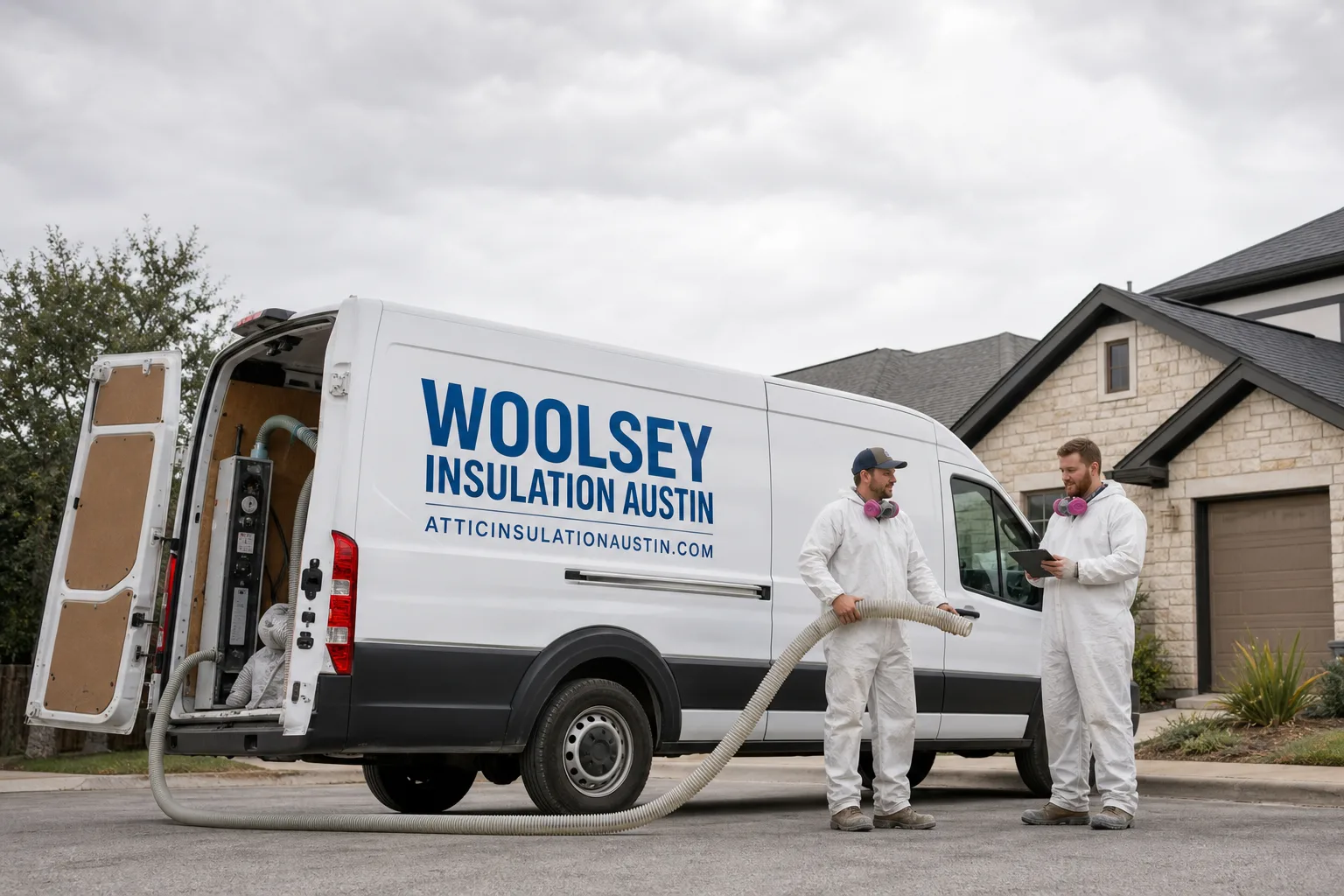
Attic Insulation Near You in Austin, TX
If you’re searching for attic insulation near you in Austin, you want a crew that shows up fast, prices the job honestly, and doesn’t leave you wondering whether the work was done right. Woolsey Insulation Austin serves homeowners across the Austin metro, and we answer the phone live around the clock. Call (361) 418-9997 and you’ll get a real person who can schedule a visit and get you a written price before any work starts.
We install and service attic insulation only. That’s it. No HVAC, no roofing, no windows. Just the space above your ceiling, done carefully and backed by the Kingswell Guarantee: a written price, a real arrival window, a clean job site, and a written guarantee on every job. Whether you’re in Hyde Park, Mueller, Circle C, or up in Cedar Park, the process is the same. You call. We show up. We tell you exactly what it costs before we touch anything.
If you already know you need attic insulation replacement or a full attic air seal, the fastest path is a phone call. But if you want to understand what’s involved, what it costs, and how fast we can get there, keep reading.
Looking for a broader look at the service across the city? Start with our main Attic Insulation in Austin page, then come back here if you want the quick local version.
What Does Attic Insulation Cost in Austin?
Most attic insulation jobs in Austin run between $1,800 and $5,500 depending on attic size, existing insulation depth, and whether you choose blown-in attic insulation, blown-in cellulose, or spray foam. You get the exact written number before any work starts, not after. That’s the Kingswell way, and it’s part of why homeowners who have been burned by door-step price changes tend to stay with us.
Here’s a realistic breakdown by material for a typical 1,500 to 2,000 square foot Austin home:
- Blown-in fiberglass: $1,800 to $3,200. Fast to install, solid air-sealing when paired with proper venting.
- Blown-in cellulose: $2,200 to $3,800. Dense, good at slowing airflow, made from recycled material.
- Spray foam insulation (open-cell or closed-cell applied to the roofline): $3,500 to $5,500 or more depending on square footage and depth.
Those ranges reflect what we see across Austin, from South Congress bungalows to new builds in Kyle and Hutto. An older home with patchy, settled insulation usually costs less than a full spray foam conversion, but every attic is different. The only way to know your real number is to have someone who knows attics walk the space and measure.
We work with eight leading insulation brands, including Owens Corning, Johns Manville, Knauf, Rockwool, CertainTeed, Icynene, Demilec, and GreenFiber. That matters because the material recommendation should fit the home, not whatever happens to be on the truck. If your attic needs moisture-resistant closed-cell foam, we’ll tell you. If blown-in cellulose is the better value for your roof line, we’ll tell you that too. You get a recommendation based on the house in front of us, not the warehouse inventory behind us.
Why Austin Homeowners Call Us First
Austin’s climate punishes bad attic insulation. Summer heat radiates through the roof deck every afternoon, and a poorly insulated attic can push temperatures above 140 degrees by mid-July. That heat soaks into the ceiling below and forces your air conditioner to run longer and harder than it should. In winter, the same gaps and thin spots let warm air rise out of the living space and into the attic, where it condenses against cool surfaces and invites mold and rot.
We see this pattern constantly in neighborhoods like Allandale, Crestview, and Rosedale, where homes built before modern energy codes often have four to six inches of settled insulation when the attic really needs twelve to eighteen inches. The problem isn’t always age. Sometimes a previous contractor simply didn’t install enough. Sometimes an addition was built without a proper attic seal. Sometimes a roofing repair knocked insulation out of place and nobody noticed.
Whatever the cause, the fix starts with an honest look at what you have. That’s what we do. We don’t sell insulation over the phone by square footage. We put a background-checked, uniformed technician in your attic, take real measurements, check for airflow problems at the soffits and baffles, and then give you a written price. No pressure, no same-day discount games, no “while we’re here” upsell.
Glenn Hartley leads our Austin operation, and the standard he holds is simple: write down what you’re going to do, do what you wrote down, and come back if it fails. That’s the entire promise, and it’s backed by the 365-Day Done Right Promise. If it’s not done right within a year, we make it right, in writing, at no charge. Not a pro-rated credit. Not a service fee. A fix.
Fast, Local Attic Insulation
We answer the phone live, 24 hours a day, seven days a week. No voicemail maze, no automated system, no “press 2 for new installations.” You call (361) 418-9997, a person picks up, and you get a straight answer about scheduling.
For most Austin homeowners, we can have a technician at your home within 24 to 48 hours of your call, often faster if you’re flexible on timing. Same-day visits are available for some jobs depending on where the crew is that morning. We keep our service area tight enough that response times stay predictable, and we don’t overbook crews into impossible windows. When we say we’ll arrive between 9:00 and 11:00, that’s when the truck pulls up.
Here’s how a typical job runs under the Kingswell Guarantee:
- Step 1: You call, a live person answers, and we schedule a visit.
- Step 2: A background-checked, uniformed technician walks your attic, checks depth, condition, venting, and air leaks, and measures the space.
- Step 3: You get a written price before any work starts. That price doesn’t change at the door, after the crew arrives, or halfway through the job.
- Step 4: The crew installs the insulation, cleans up the work area, and leaves the attic tidier than they found it.
- Step 5: You get a written guarantee on the work. If anything fails within 365 days, we come back and fix it at no charge.
There’s no secret phrase or special program. That’s just how we work. Wool was the first insulation. Woolsey keeps the idea in the name. And the name stands behind the work for a full year, in writing, every single job.
Areas We Cover
We serve homeowners across the Austin metro, from the central neighborhoods to the outer suburbs. Our crews regularly work in Austin proper as well as Georgetown, Leander, Kyle, Hutto, Lakeway, Bastrop, and Manor. If you’re in one of those communities and you search “attic insulation near me,” we’re close enough to reach you fast.
For a look at the service across the broader region, visit our home page to see how we approach attic insulation city by city. Each Woolsey location is independently owned and operated under the Kingswell banner, which means the team serving your neighborhood is local to Texas and accountable to Texas homeowners, not to a corporate office in another state.
What Type of Insulation Is Right for an Austin Attic?
Three main options dominate Austin attics, and each has a specific job. The right one depends on your roof design, your budget, and how your attic is vented.
Blown-in fiberglass is the most common choice for open attics with standard venting. It’s installed as loose material that settles into a thick blanket across the attic floor, and it’s fast to install and easy to top up later. For most Austin homes, we recommend R-38 to R-60 depending on the attic’s configuration and the home’s age.
Blown-in cellulose is denser than fiberglass and does a better job slowing air movement through the insulation itself. It’s made primarily from recycled paper treated with a fire retardant, and it’s a strong value for older attics where air leakage is the bigger problem. In homes around Travis Heights and Bouldin Creek with sloped ceilings and irregular joist bays, cellulose often packs into odd corners better than fiberglass batts.
Spray foam insulation is a two-part liquid that expands on contact and seals gaps airtight. It’s the best choice when you want to turn the attic into conditioned space or when you’re fighting humidity and air infiltration. Closed-cell foam adds structural strength and acts as a vapor barrier; open-cell foam is lighter and less expensive per board foot. This is also the most expensive option, and it’s not always necessary. If we recommend it, we’ll explain exactly why in plain language.
One caution: spray foam installation involves chemical components that require careful handling and proper ventilation during application. This isn’t a weekend DIY project. A trained professional should always handle spray foam application, both for safety and for the warranty to mean anything.
R-value is the trade term for insulation’s resistance to heat flow. Higher numbers mean better resistance. An attic in Austin should generally have at least R-38, and many homes we inspect need R-49 or R-60 to perform well through Texas summers. The exact number for your home depends on the roof’s construction and the existing insulation, and it’s one of the first things we calculate when we walk the space.
Signs Your Austin Attic Needs Insulation Work
Some attics announce their problems loudly. Others fail quietly while your electric bill climbs month after month. Here are the signals we look for, and the ones homeowners in Austin should watch for too:
- Upstairs rooms stay hot in July no matter how low you set the thermostat. This is often the ceiling absorbing heat from a superheated attic.
- Your energy bill spikes every summer even though your AC unit is newer and properly maintained.
- You can see the ceiling joists when you peek through the attic hatch. If the insulation sits below the top of the joists, it’s probably too thin.
- The attic smells musty or you see dark staining on the roof deck. That’s moisture, and it often points to airflow problems tied to missing or compacted insulation.
- Rooms feel drafty in winter and warm air seems to disappear upward. Heat rises, and a poorly insulated attic lets it escape.
- You find pests in the attic. Squirrels, rats, and raccoons love fiberglass insulation as nesting material, and they’ll tear it apart fast.
If any of these match your house, call us. The diagnostic process is straightforward, and you’ll get an honest answer even if the recommendation is “your insulation is fine, you have a different problem.” We’d rather tell you that and lose the job than sell you insulation you don’t need. The 365-Day Done Right Promise means we’re accountable for what we install, and that accountability starts with only recommending work that actually helps.
How Much Insulation Does an Austin Attic Need?
The Department of Energy recommends R-49 to R-60 for attic insulation in our climate zone. Many Austin homes fall far short. We regularly measure four to six inches of old, compressed fiberglass in 1950s and 1960s homes across the city, which translates to roughly R-11 to R-19. That’s less than half of what the attic should carry.
Here’s a quick reference for what different depths of blown-in fiberglass typically provide:
- 6 inches: roughly R-19. Common in older homes, far below recommendation.
- 10 inches: roughly R-30. Better, but still thin for Texas summers.
- 14 inches: roughly R-38. The minimum we’d want to see in most Austin attics.
- 18 to 20 inches: roughly R-49 to R-60. Where most homes should be.
Blown-in cellulose provides a slightly higher R-value per inch, around R-3.2 to R-3.8, so 8 to 10 inches might hit R-30 to R-38 depending on density. The point isn’t to memorize these numbers. The point is that depth matters, and settled or compressed insulation reads far lower than its original rating. If you’re not sure what you have, we measure it and tell you.
How We Keep Attic Work Safe and Clean
Attic work carries real risks, and we don’t gloss over them. Attics in Austin climb above 140 degrees in summer. Loose electrical connections, recessed light fixtures, and old knob-and-tube wiring hide under insulation and demand care. Crawling across joists in a tight attic is physically demanding and potentially dangerous for anyone who doesn’t do it every day.
That’s why we send trained, background-checked, uniformed technicians, not day laborers. Our crews know how to insulate around recessed can lights without creating a fire hazard, how to keep soffit vents clear so the attic can breathe, and how to work without trampling through HVAC ducts or crushing existing insulation where it should stay. They wear proper protective gear, use headlamps and respirators where needed, and they treat your home like a place where people live.
After the work is done, the job site gets cleaned. We remove old insulation debris where replacement is part of the scope, vacuum up loose material, and leave your hallway and attic access as clean as we found them. If anything is out of place, you have our number, and a live person picks up. That’s how the Kingswell Guarantee works after the crew leaves too.
One safety note for homeowners: if you’re considering opening up a wall or moving fiberglass yourself, wear a proper respirator, goggles, and gloves. Loose fiberglass particles irritate skin, eyes, and lungs. And if you see vermiculite insulation in an older Austin home, don’t disturb it until it’s been tested. It may contain asbestos, and only a trained professional should handle it.
Does Attic Insulation Actually Lower Energy Bills in Austin?
Yes, and the difference can be significant. Austin Energy data shows that heating and cooling account for roughly half of the average home’s annual energy use. A poorly insulated attic forces the AC to run longer through every summer afternoon, and it lets warmth escape all winter. Upgrading from R-19 to R-49 can cut the cooling load through the attic by 50 percent or more, and homeowners often notice the change within the first month.
We don’t promise a specific dollar amount on your bill. Too many variables affect that number: your AC unit’s efficiency, your window quality, your thermostat habits, your home’s orientation. What we do promise is that the attic will hold more of the air you pay to condition, and that the work will be done to the written specification we agreed to before the crew arrived.
If you want a more complete picture of attic insulation across the city, our Attic Insulation in Austin page walks through the full service in more detail. This page is the quick local overview for when you’re searching “attic insulation near me” and want the essentials: who we are, how fast we come, what it costs, and what happens next.
FAQs
How fast can you get to my Austin home for attic insulation?
We can usually get a technician to your home within 24 to 48 hours of your call, and same-day visits are sometimes available depending on the day’s schedule. The fastest way to find out is to call (361) 418-9997 and speak with a live person, not a voicemail.
Do you serve my area near Austin?
We serve Austin and the surrounding communities including Georgetown, Leander, Kyle, Hutto, Lakeway, Bastrop, and Manor. If you’re inside the Austin metro, there’s a very good chance we cover your neighborhood. Call us and we’ll confirm immediately.
How much does attic insulation cost in Austin?
Most attic insulation jobs in Austin run between $1,800 and $5,500 depending on attic size, material, and existing insulation depth. You get a written price before any work starts, and that number doesn’t change at the door. Estimates are free, so call (361) 418-9997 for an exact quote on your house.
Can I call after hours or on weekends?
Yes. A live person answers our phone 24 hours a day, 7 days a week. There’s no voicemail system and no automated menu. If you call at 9pm or 7am, a real person picks up and helps you schedule a visit.
Written by Glenn Hartley, Owner at Woolsey Insulation Austin, serving Austin and nearby areas.
What Our Customers Say
"Insulation job was done well. Scheduling took a little longer than I'd have liked, they were booked out a couple weeks. But once they came it was quick and the house is cozier."
- Felicia Grant"Spray foam in the crawlspace and new attic insulation. They wrote up the whole price and the two jobs came in exactly as quoted. Floors upstairs aren't freezing in the morning anymore."
- Nathan Pruitt"Showed up on time, laid down protection on the floors, and were careful going into the attic. Explained exactly what they were doing and why. House holds its heat so much better now."
- Preston Hale