
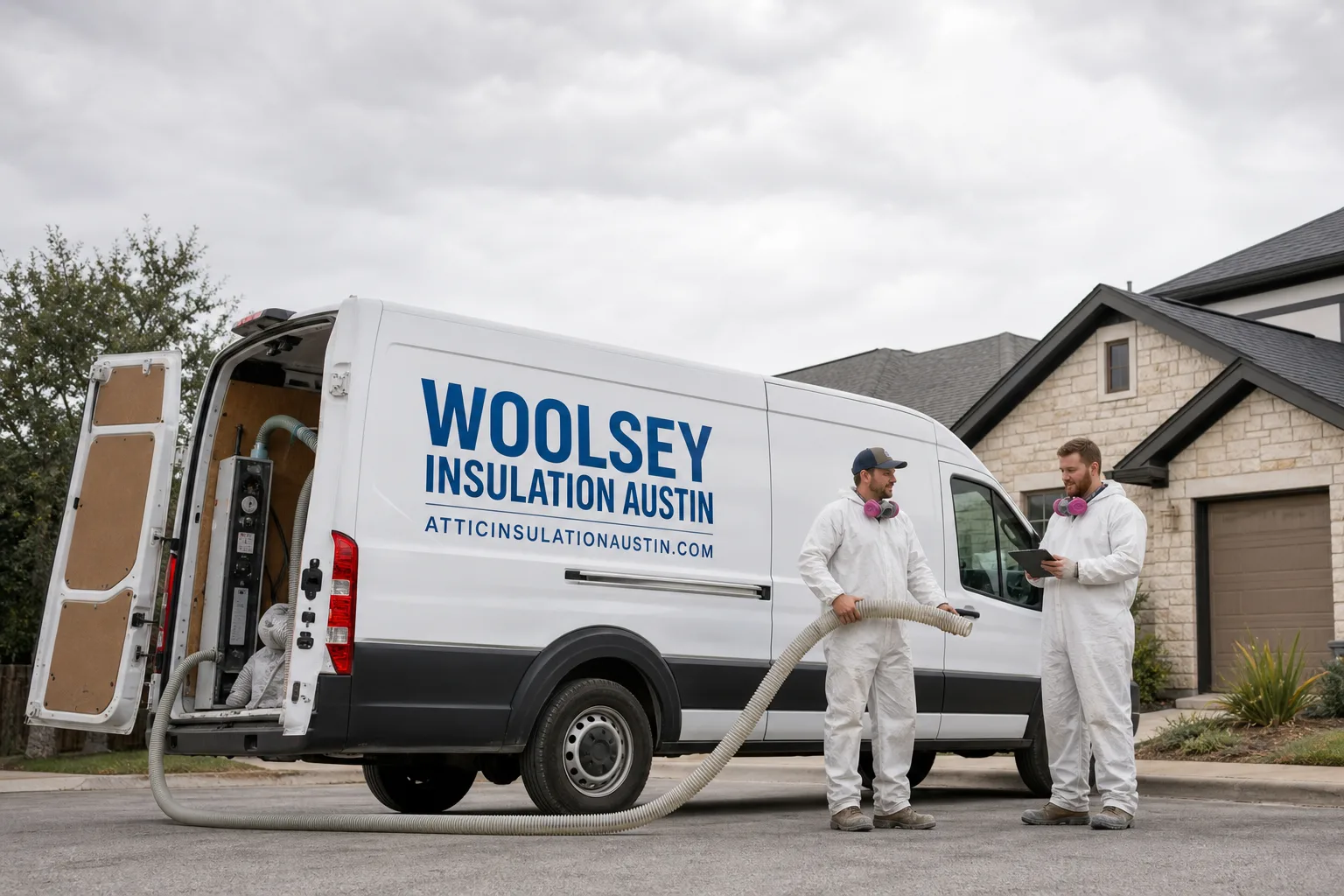
How Much Does Attic Insulation Cost in Austin?
Our Attic Insulation services in Austin, TX typically run between $1,800 and $5,400 for a standard 1,500-square-foot attic, with most homeowners paying around $3,200 for blown-in fiberglass or cellulose. The two big cost drivers are the insulation type you choose and the current depth of what’s already up there. Every Woolsey job starts with a written price before any work begins, so the number we quote is the number you pay.
If your attic floor shows ceiling joists, you don’t have enough insulation. On this page, we’ll walk through exact 2026 pricing for Attic Insulation Near Me in Austin, TX, why some attics run higher than others, how we keep prices honest, and what questions get asked most often. We’ll also share what we see in specific Austin neighborhoods like Crestview, Mueller, Tarrytown, and Circle C.
Key Takeaways
- Typical Austin attic insulation job: $1,800 to $5,400 for a 1,500 sq ft attic, based on 2026 pricing.
- Blown-in fiberglass: $1.40 to $2.80 per square foot installed.
- Blown-in cellulose: $1.20 to $2.40 per square foot installed.
- Spray foam (open-cell): $2.50 to $4.50 per square foot installed.
- Spray foam (closed-cell): $3.75 to $6.50 per square foot installed.
- Most jobs finish in one day. Larger or spray foam jobs may run into a second morning.
- Free written estimates: call (361) 418-9997 and we’ll give you an exact number before any work starts.
Attic Insulation Cost Breakdown (2026)
Here’s a line-item look at what Austin homeowners paid in the last 12 months. These are real ranges we see on the ground, not national averages from a database.
| Insulation Type | Cost Per Sq Ft (Installed) | Typical 1,500 Sq Ft Attic | Best For |
|---|---|---|---|
| Blown-in fiberglass | $1.40 – $2.80 | $2,100 – $4,200 | Most Austin homes; quick install |
| Blown-in cellulose | $1.20 – $2.40 | $1,800 – $3,600 | Older homes; good sound dampening |
| Batt fiberglass (R-30 to R-38) | $1.10 – $2.20 | $1,650 – $3,300 | Open attics with no obstructions |
| Spray foam (open-cell) | $2.50 – $4.50 | $3,750 – $6,750 | Unvented attics; air sealing |
| Spray foam (closed-cell) | $3.75 – $6.50 | $5,625 – $9,750 | Maximum R-value per inch; humidity control |
Those numbers include labor, material, and a written Kingswell Guarantee on every job. They don’t include old-insulation removal, which runs $1.00 to $1.75 per square foot when it’s actually needed. Many Austin attics don’t need it. If yours does, we’ll tell you why with photos from our inspection.
What Drives the Price Up or Down
The biggest swing factor is insulation type. Blown-in fiberglass is the workhorse in Austin; it’s fast, it’s affordable, and it hits the Department of Energy’s R-38 recommendation for our climate zone. Spray foam costs more because it’s a two-part liquid that expands on contact and seals gaps airtight, which means we’re installing a thermal barrier and an air barrier at the same time. That matters in a city where August temperatures routinely sit at 100 degrees and the attic can hit 140.
Access is the second swing factor. A wide attic with a pull-down stair and standing headroom is a one-day job. A low-pitch roof with 18 inches of clearance above the ceiling joists takes longer. We price that honestly in the written quote, before anyone moves a single bag of material.
What Affects Attic Insulation Pricing in Austin
- Current insulation depth. If you have R-13 and we’re bringing you to R-38, we add less material than going from bare ceiling to R-38. In Crestview and Allandale, we regularly see 1960s homes with an inch of rock wool or nothing at all, which means a bigger job than a 2010s house in the suburbs.
- Attic access and headroom. Homes in Hyde Park and Bouldin Creek, with their steep roof pitches and narrow attic hatches, take longer than a subdivision home in Pflugerville or Round Rock where the attic truss system leaves open space. Time is part of the price.
- Insulation type. Blown-in fiberglass and cellulose are the most affordable. Spray foam costs more up front but cuts air leakage, which is a real issue in older Austin houses where the attic hatch leaks like an open window.
- Air sealing. Before we blow in new insulation, we seal the gaps around plumbing vents, recessed lights, and the attic hatch. That air-sealing step adds $200 to $500 but pays for itself in reduced AC runtime during the first Austin summer.
- Old insulation removal. If there’s been a roof leak, rodent damage, or the existing insulation is saturated with dust from decades of Texas heat, we recommend removal before installing new material. Removal adds $1.00 to $1.75 per square foot.
- Rebates and utility incentives. Austin Energy offers rebate programs for attic insulation upgrades, and many of our customers qualify. We’ll walk you through the paperwork. It can knock $300 to $1,100 off the total, depending on the program year.
How to Save on Attic Insulation
First, get three written quotes. Not phone estimates, not ballpark numbers. Written quotes you can hold side by side. Then compare the material type, the R-value, and the guarantee that comes with each. The lowest price often has no guarantee attached, and when you’re paying for a material that sits between you and a Texas summer, the guarantee is part of the product.
Second, look at rebates before you sign anything. Austin Energy’s insulation rebate program changes year to year but typically covers a meaningful portion of the material cost. We’ll run that check for you during the estimate.
Third, don’t put off air sealing. It’s the cheapest line item on the quote and it’s the one that makes the insulation you already paid for actually work. A $300 air-sealing pass can do more for your July electric bill than $1,500 worth of extra insulation.
Most of our customers save more by calling us first than by shopping around after a low-ball quote falls apart. Call (361) 418-9997 and ask for a free written estimate. We’ll give you a number, a window, and a guarantee. All in writing.
Common Attic Insulation Problems We See in Austin Homes
In the neighborhoods we work most often, we see the same five issues repeating. Here’s what they look like and what they cost to put right.
1. Undercut Insulation That Doesn’t Reach R-38
Most Austin homes built before 2000 have between R-11 and R-19 in the attic. In Travis County, the Department of Energy recommends R-38 to R-60 for Zone 2 climates. We see the gap every day: a home in Westlake with fiberglass batts compressed to an inch thick, or a 1970s ranch in Brentwood with a scattering of loose fill that’s drifted away from the eaves. Attic Insulation Top-Up to bring an under-insulated attic to R-38 runs $1,800 to $3,600 on a standard home, and it’s the single most cost-effective energy upgrade you can make in Austin, where cooling costs run eight months of the year.
2. Air Leaks Around the Attic Hatch, Vents, and Recessed Lights
Insulation doesn’t stop air movement. It slows heat transfer. If your attic hatch has gaps around the edges, or your recessed light housings leak conditioned air into the attic, you’re paying to cool the roof deck. We air-seal every job before we add insulation, and we’ll point out where the leaks are with photos so you can see what we’re fixing. The air-sealing pass adds $200 to $500 and it’s often the difference between “we added insulation and it helped a little” and “our July bill dropped by a third.”
3. Insulation That’s Been Soaked by a Roof Leak or Broken AC Drain Pan
In Austin, the biggest attic moisture problems come from two places: roof leaks during the spring storm season, and AC drain pans overflowing because the primary line clogged. Wet insulation loses its R-value and breeds mold. We see this in neighborhoods like Cherrywood and Mueller where older roof systems meet newer HVAC equipment. Wet insulation needs Attic Insulation Replacement before new insulation goes in, and we’ll show you exactly what we found during the inspection.
4. Rodent Damage in the Attic
Squirrels and roof rats are a year-round reality in Austin, especially in neighborhoods with mature oak trees like Tarrytown, Clarksville, and parts of Northwest Hills. Rodents tunnel through fiberglass and cellulose, compressing it and saturating it with waste. We’ll identify active nesting areas, recommend removal, and install new insulation once the space is clear. We won’t blow new material over a rodent problem; that’s a waste of your money.
5. Spray Foam That Was Installed Incorrectly
We get calls from homeowners who paid another contractor for spray foam and ended up with off-ratio foam that cured soft, shrank away from the rafters, or never fully expanded. Off-ratio foam is a chemical problem, not a cosmetic one, and it often has to be removed and replaced. We work with open-cell and closed-cell foam from Icynene, Demilec, and others, and we hold the manufacturer’s material specs on every project so the final result is exactly what the label says.
How Woolsey Runs an Attic Insulation Job in Austin
Every job follows the same sequence, and we put each step in writing before we start. It’s how we’ve worked since Glenn Hartley founded the company in 2002, and it’s what the Kingswell Guarantee is built on.
Step 1: The inspection. We walk the attic, measure the current depth, check for air leaks, moisture, and rodent activity, and take photos of everything we find. The inspection is free. You keep the photos whether you hire us or not.
Step 2: The written quote. We give you a line-item price on paper. Material, labor, air sealing, any removal work, any rebate documentation we’ll handle. That price doesn’t change at the door.
Step 3: The arrival window. We commit to a window, we show up in it, and we call if anything changes. Our technicians wear uniforms and have passed background checks, so you know exactly who’s walking into your home.
Step 4: The install. Most blown-in jobs finish in a single day. Spray foam can run into a second morning. We cover the work area, keep the hose and equipment out of your living space, and clean up at the end of each day.
Step 5: The Kingswell Guarantee, in writing. Every installation and repair includes a written guarantee. If anything isn’t right within 365 days, we come back and fix it at no charge. No phone trees, no “we’ll get back to you.” A live person answers the phone when you call.
Wool was the first insulation. Woolsey keeps the idea in the name. And like our home page explains, we’ve spent twenty-plus years in Austin attics learning what hot Texas summers do to a ceiling.
FAQs – Attic Insulation Cost in Austin
How much does attic insulation cost in Austin for a 2,000 sq ft home?
A 2,000 sq ft home in Austin typically runs $2,400 to $5,600 for blown-in fiberglass or cellulose, and $6,000 to $11,000 for spray foam. The exact number depends on your current insulation depth, attic access, and the material you choose. Call (361) 418-9997 for a free written estimate and we’ll give you the exact figure for your home.
Is it cheaper to do attic insulation yourself in Austin?
Buying bags of blown-in fiberglass at a home center runs about $0.50 to $0.80 per square foot for material, but renting the blower, hauling the material into the attic, and doing a consistent depth across the entire floor is a full day’s work for two people. Most homeowners find that after the equipment rental and the inevitable re-buy of material they under-bought, the savings shrink to a few hundred dollars, and they’re left with no guarantee. Our Attic Insulation in Austin page goes into more detail on what’s involved.
Can you insulate an attic in Austin in one day?
Yes. Most blown-in fiberglass and cellulose jobs on standard-size homes finish in a single day. Spray foam and homes with difficult access or old insulation removal may take into a second morning. We’ll tell you the expected duration in the written quote.
How much does spray foam attic insulation cost in Austin?
Open-cell spray foam runs $2.50 to $4.50 per square foot installed, and closed-cell runs $3.75 to $6.50. For a 1,500 sq ft attic, that means $3,750 to $9,750 depending on the foam type and roof deck configuration. We work with Icynene and Demilec products and can show you the difference in R-value, air sealing, and installed cost for your specific attic.
What R-value does attic insulation need in Austin?
The Department of Energy recommends R-38 to R-60 for attics in Travis County’s climate zone. Most Austin homes built before 2000 have R-11 to R-19, which means they’re running at less than half the recommended thermal resistance. Bringing your attic to R-38 is the standard we quote for most homes.
Do you remove old attic insulation before installing new insulation?
Only when it needs to come out. We recommend removal when insulation is water-damaged, rodent-soiled, or so deteriorated it’s trapping moisture against the ceiling. Removal runs $1.00 to $1.75 per square foot. If your existing insulation is dry and intact, we can often blow new material directly over it and save you that cost.
Are there attic insulation rebates available in Austin?
Austin Energy has offered rebate programs for attic insulation upgrades in recent years, typically $300 to $1,100 depending on the program and the scope of the work. We’ll check your eligibility during the estimate and help with the paperwork. Call (361) 418-9997 and we’ll tell you what’s currently available.
Written by Glenn Hartley, Owner at Woolsey Insulation Austin, serving Austin and surrounding communities since 2002.
Pricing reflects the Austin market as of 2026. Woolsey Insulation Austin offers free estimates – call (361) 418-9997.
What Our Customers Say
"Our old insulation was flattened and basically useless. They removed it, cleaned up, and blew in new. Furnace isn't running constantly anymore and the first bill already showed it."
- Carl Yeung"Good work and a fair price on spray foam in the garage. The crew did track a bit of the old insulation through the garage, but they vacuumed it up before they left. Garage is way warmer now."
- Brenda Falk"The guy didn't try to sell me on foaming the whole house. He said the attic was where I'd actually feel it and left it at that. Honest, and he was right, our bills dropped."
- Angela Ruiz